Workshops
Workshops
Acting, Voice & Public Speaking Workshops for Companies, Drama Schools and Universities.
Scene Study Verônica Sarno offers workshops and professional training in acting, script analysis and scene study, vocal technique, and public speaking for drama schools, universities, theatre companies, and corporate organisations.
Drawing on professional acting techniques, Laban Movement Analysis, and the Stanislavski System, Verônica delivers practical, engaging workshops that develop artistic skills, vocal confidence, stage presence, and effective communication.
Each workshop can be tailored to your organisation’s needs, whether you’re in the development or rehearsal phase of a stage or screen production, training actors, supporting performing arts students, or helping professionals communicate with greater clarity, confidence, and impact.
Available workshops:
- Branding for Actors: The Business Side of Acting
- Scene Study Advanced: Script Analysis & Scene Practice
- Mechanics of the Voice: Vocal Technique for the Spoken Voice
- The Power of Communication: Public Speaking That Connects
Bring a workshop to your organisation. Get in touch via scenestudyveronicasarno@gmail.com
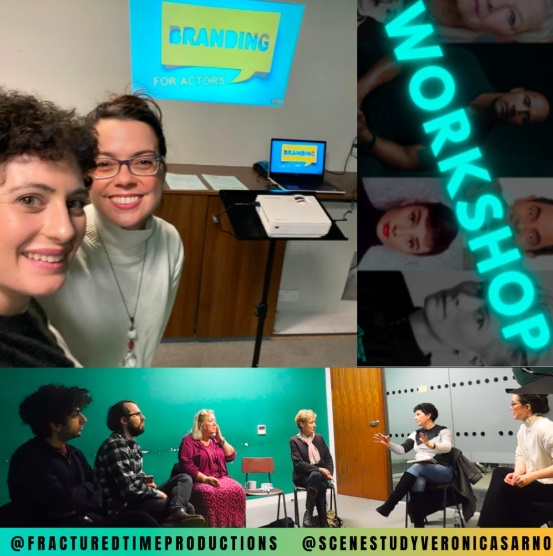
1. BRANDING FOR ACTORS – The business side of acting
Are you unsure which roles best suit you, which auditions to pursue, or how to present yourself to the industry? This practical workshop is designed to help you gain a clearer understanding of your identity as an actor and how to communicate it with confidence.
Created in partnership with Fractured Time Productions, the workshop explores the business side of acting, helping you identify what makes you unique and develop a more focused, authentic professional profile.
Whether you are starting your acting career or looking to refine how you present yourself to the industry, you will gain practical tools to make informed career choices, approach opportunities strategically, and communicate your strengths more effectively.
In a competitive industry, talent is essential, but so is understanding your artistic identity. Developing your personal brand can help casting directors and other industry professionals recognise your qualities, understand your casting potential, and see how you might fit into their projects.
The Method
The workshop combines guided reflection, practical exercises, and discussion to help actors explore their individual qualities, strengths, and professional aspirations.
Through a series of structured activities, you will investigate how your appearance, personality, skills, experience, and artistic interests contribute to your identity as an actor. You will then explore how to translate these discoveries into a clear and authentic professional profile that supports your choices around auditions, roles, and career opportunities.
The emphasis is on developing a personal brand that reflects who you are as an actor, rather than creating an artificial image or trying to fit a predetermined mould.
What Will You Work On?
- Understanding Actor Branding: Exploring what personal branding means in the acting industry and how it can support your career.
- Identifying Your Strengths: Recognising your distinctive qualities, skills, experience, and artistic interests.
- Casting Potential & Role Selection: Developing a clearer understanding of the roles and characters that may align with your current profile and strengths.
- Defining Your Professional Identity: Articulating what makes you distinctive and what you bring to a project.
- Presenting Yourself to the Industry: Exploring how to communicate your profile with greater clarity and authenticity.
- Career Choices & Opportunities: Learning to approach auditions and professional opportunities with greater focus and intention.
By the End of the Workshop, You Will…
- Have a clearer understanding of actor branding and how to use it to support your career.
- Be better equipped to identify, define, and communicate your strengths and distinctive qualities.
- Have practical tools to develop and present an authentic personal brand as an actor.
- Feel more confident making decisions about roles, auditions, and professional opportunities.
The aim is to help you understand what makes you distinctive as an actor and how to communicate that identity with clarity, confidence, and purpose.
2. SCENE STUDY ADVANCED: Script Analysis and Scene Practice
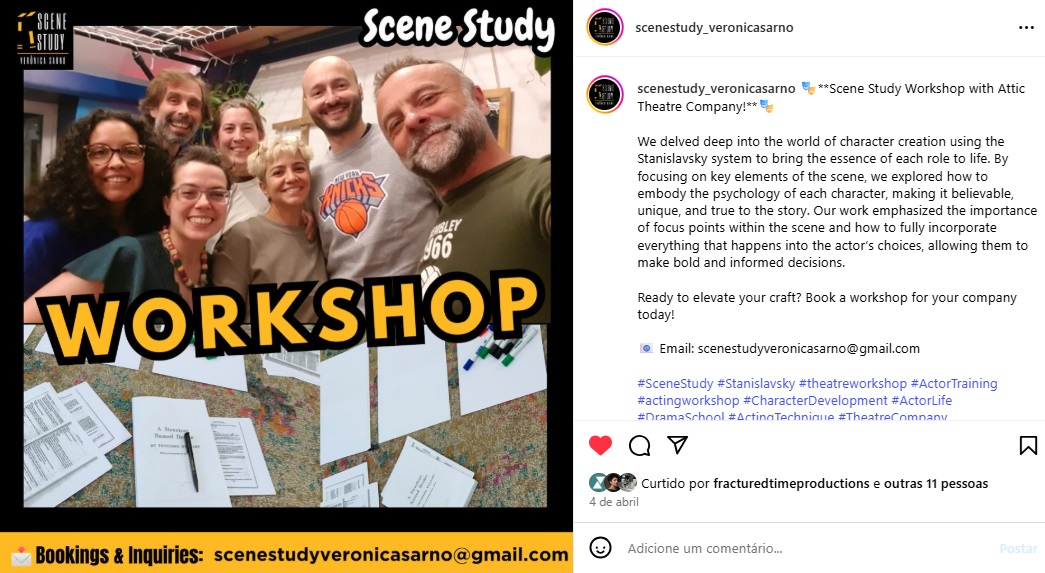
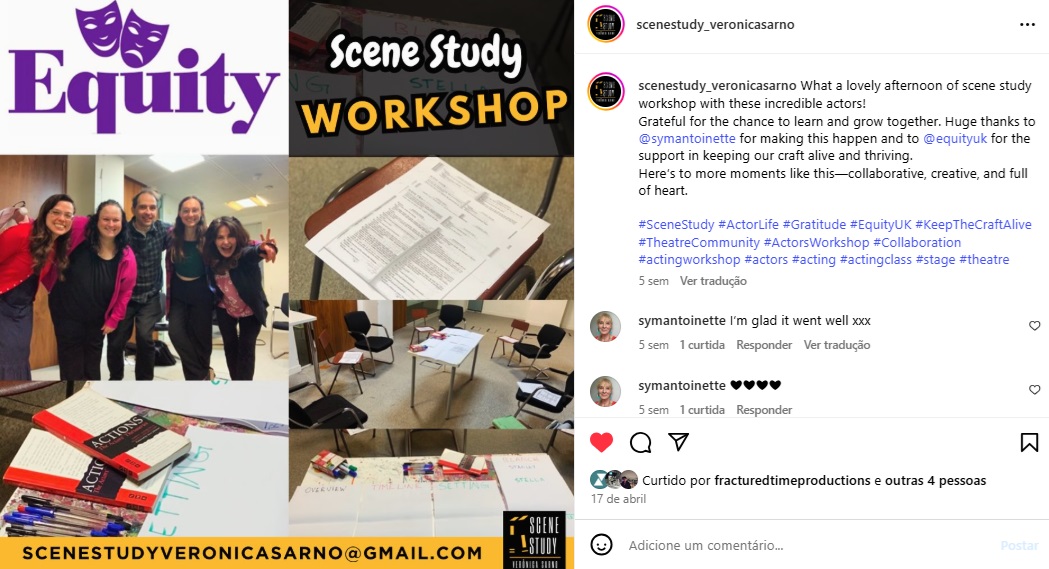
This practical acting workshop explores the relationship between script analysis and performance through the two phases of Konstantin Stanislavski’s work: round-the-table analysis and Active Analysis.
The workshop helps actors develop a deeper understanding of the script by learning what questions to ask, what information to look for, and how to use their findings to build a character within the circumstances of the story.
Through script analysis, scene investigation, improvisation, and physical actions, actors learn to translate their discoveries into practice, connecting the character’s thoughts, emotions, memories, intentions, relationships, and physical behaviour to create a more detailed and truthful performance.
The aim is to develop the actor’s investigative skills, strengthening their ability to analyse a text, make informed creative choices, and embody those choices in performance.
The Method
Based on Stanislavski’s principles, the workshop integrates two complementary aspects of his work: round-the-table analysis and scene practice through physical actions and Active Analysis.
Round-the-table analysis provides the foundation for an in-depth investigation of the script. Actors learn to examine the given circumstances, identify objectives and actions, explore relationships and subtext, and uncover the information needed to understand the world of the play or screenplay.
The workshop can be applied to a variety of material, including theatre plays, screenplays, film and television scripts, monologues, etc.
What Will You Work On?
- Script Analysis: Stanislavski’s Seven Questions, given circumstances, scene structure, and scene breakdown.
- Character Study & Development: Investigating the character’s objectives, intentions, actions, relationships, and inner life.
- Subtext & Actioning the Text: Exploring what lies beneath the words and identifying playable actions that bring the text to life.
- Active Analysis & Scene Practice: Using improvisation, physical actions, and practical acting exercises to explore the scene and put discoveries into practice.
Through this process, actors develop a more investigative approach to their craft, learning how to move from analysing a script to making specific, embodied choices in performance.
This investigation then moves into practice. Through physical actions, improvisation, and active exploration of the scene, actors experiment with their discoveries and investigate how the information gathered from the text can inform their performance.
3. MECHANICS OF THE VOICE: Vocal Technique for the Spoken Voice.
This practical voice training workshop helps participants develop a more mindful relationship with their voice and respiratory system, enabling a healthier, more confident, and more effective use of the spoken voice in everyday and professional situations.
Through practical exercises combining body awareness, breathing, vocal technique, and text work, participants learn to improve vocal clarity, resonance, articulation, projection, and expressive delivery.
The workshop is suitable for actors, performing arts students, teachers, and professionals who want to develop their vocal skills and communicate with greater confidence, clarity, and intention.
The Method
The workshop is divided into two parts, moving from body and voice awareness to the practical application of vocal technique through spoken text.
Part One: Body, Breath & Voice
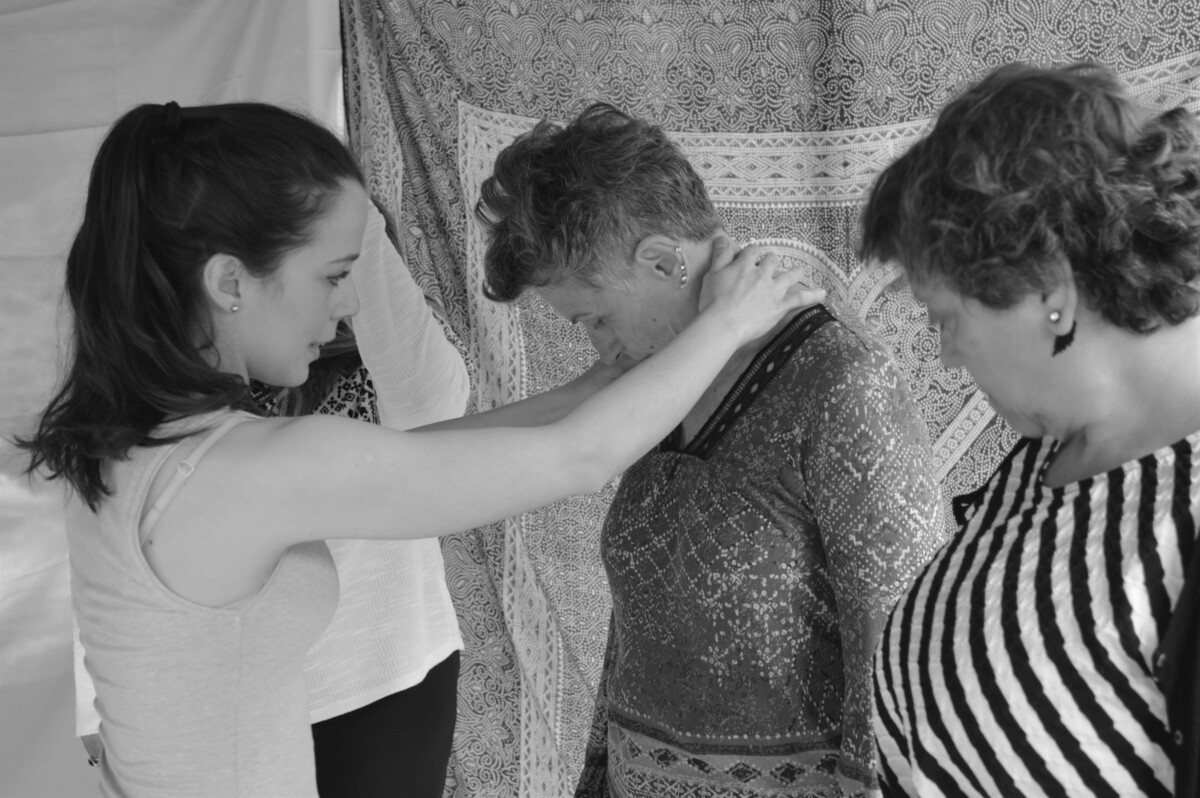
The first part focuses on establishing a stronger connection between body and mind through practical exercises in relaxation, stretching, posture, breathing, and vocal awareness. Drawing on yoga- and Pilates-based movements and principles of the Alexander Technique, participants explore how physical alignment, breath, and body awareness influence vocal production.
The work also introduces vocal resonance, articulation, and projection, helping participants develop a more supported, clear, and confident spoken voice.
Part Two: Voice, Text & Interpretation
The second part explores how vocal technique connects with language and meaning. Working with a text — such as a poem, speech, monologue, or other spoken material — participants investigate reading skills, punctuation, rhythm, text analysis, and interpretation.
Through practical exercises and experimentation, participants learn how to use the voice expressively, bringing greater clarity, intention, and meaning to the words they speak.
What Will You Work On?
- Body Awareness & Relaxation: Mindfulness, relaxation exercises, stretching, and warm-ups using yoga- and Pilates-based movements.
- Posture & Alignment: Exploring principles of the Alexander Technique and their relationship to breathing and vocal production.
- Breathing & Vocal Support: Developing awareness of the respiratory system and its role in effective voice use.
- Vocal Resonance & Projection: Exploring how to develop a fuller, clearer, and more effective speaking voice.
- Articulation & Clarity: Improving the precision and intelligibility of spoken words.
- Text Analysis & Reading Skills: Working with punctuation, rhythm, phrasing, and the structure of a text.
- Vocal Expression & Interpretation: Connecting vocal choices with the meaning, intention, and emotional content of the words.
The aim is to help participants develop a more conscious and effective relationship with their voice, building the practical skills needed to speak with greater clarity, confidence, and expression.
4. THE POWER OF COMMUNICATION: Public Speaking that Connects
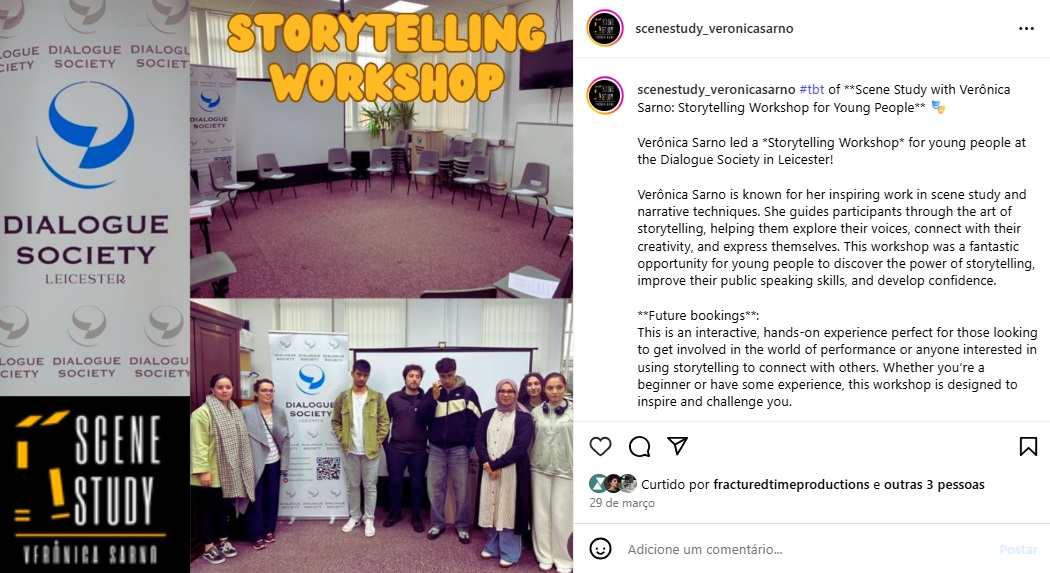
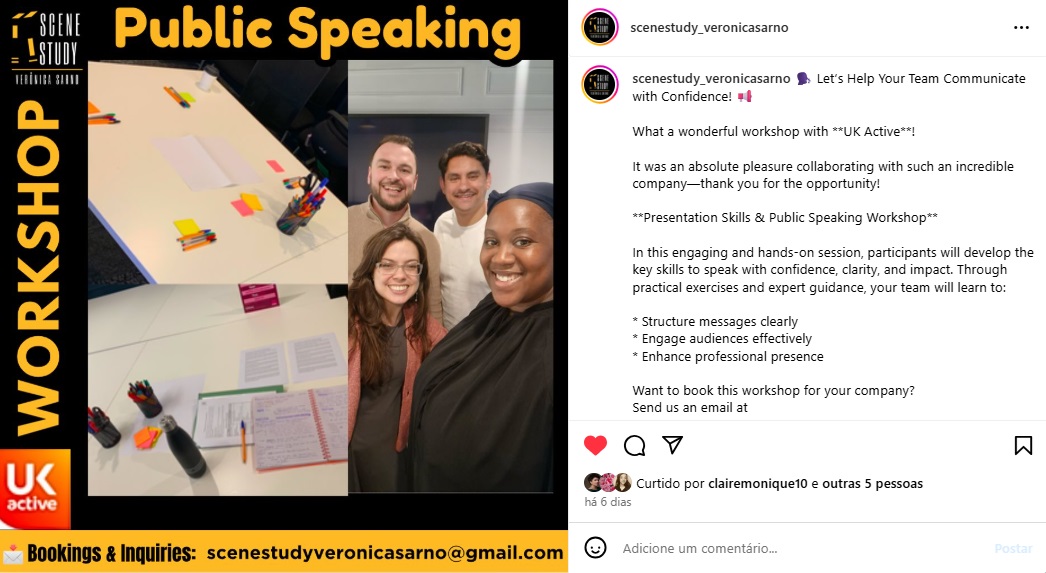
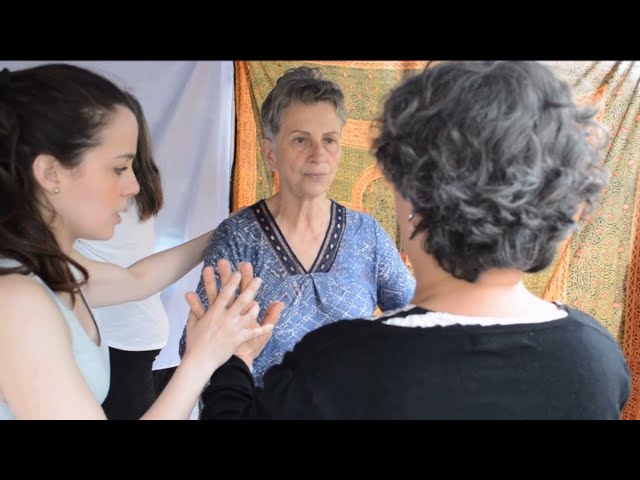
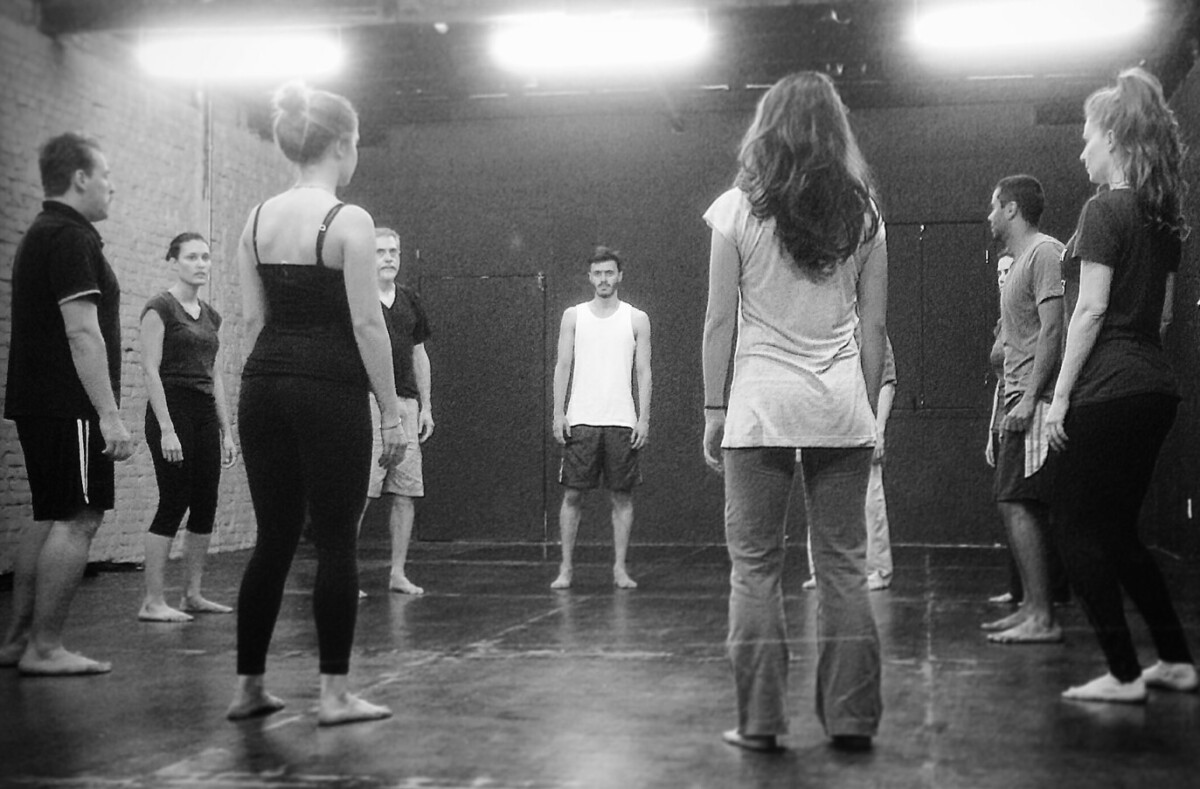
Scene Study Verônica Sarno offers tailored public speaking and communication workshops for companies and organisations looking to develop their employees’ presentation skills, professional communication, and ability to connect with an audience.
This practical, interactive workshop uses acting techniques, storytelling, and communication exercises to help participants speak with greater clarity, confidence, and impact. Participants learn to structure their ideas, communicate their message effectively, and develop a more authentic and engaging professional presence.
The workshop can be adapted to the needs of each organisation, whether participants want to improve their presentations, contribute more confidently in meetings, or communicate more effectively in professional settings.
The Method
The workshop combines practical exercises drawn from acting, voice work, improvisation, and storytelling to explore the relationship between voice, body, intention, and audience.
Through guided practice, participants develop the skills to organise their thoughts, communicate ideas clearly, and adapt their delivery to different audiences and situations. The emphasis is on learning by doing, with opportunities to experiment, practise, and apply the techniques to real professional communication challenges.
What Will You Work On?
- Structuring Your Message: Organising ideas and building clear, coherent, and engaging presentations.
- Voice & Delivery: Developing vocal clarity, articulation, pace, and projection to communicate effectively.
- Body Language & Professional Presence: Exploring posture, gestures, and physical awareness to strengthen your presence.
- Audience Connection: Learning to engage listeners, communicate with intention, and adapt your message to your audience.
- Storytelling & Authentic Communication: Using narrative and personal expression to make ideas more memorable and meaningful.
- Confidence & Improvisation: Practising how to respond naturally to questions, unexpected situations, and spontaneous interactions.
- Presentations & Meetings: Applying the techniques to presentations, professional meetings, and other workplace communication situations.
The aim is to help participants become more confident, clear, and engaging communicators, with practical tools they can apply directly to their professional lives.